

Buying a bike for a child is nothing like buying one for yourself. Children grow fast, and the temptation to buy a size up “to grow into” is strong — which is precisely the most dangerous decision you can make. This guide walks through choosing properly, step by step.
Rule one: height, not age
Two six-year-olds can differ by 15 cm in height. Choose by age and one of them ends up on a bike that is dangerously large. Every manufacturer’s chart lists age only as a rough guide — height and inseam are the numbers the decision actually rests on.
| Wheel size | Approx. age | Child height | Inseam | Suitable brakes |
|---|---|---|---|---|
| Balance bike 12" | 18 months – 3 yrs | 80 – 95 cm | 30 – 40 cm | None / light hand brake |
| 12 in | 2 – 4 years | 85 – 100 cm | 35 – 42 cm | Coaster (back-pedal) |
| 14 in | 3 – 5 years | 95 – 110 cm | 40 – 48 cm | Coaster + hand brake |
| 16 in | 4 – 6 years | 105 – 120 cm | 45 – 55 cm | V-brakes front and rear |
| 18 in | 5 – 7 years | 112 – 127 cm | 50 – 60 cm | V-brakes |
| 20 in | 6 – 9 years | 120 – 135 cm | 55 – 63 cm | V-brakes (gears appear here) |
| 24 in | 8 – 12 years | 135 – 150 cm | 62 – 72 cm | V-brake or disc |
| 26 in | 11 years + | 145 cm + | 70 cm + | Disc |
The two tests to run in the shop
1. The ground-reach test
Sit the child on the saddle at its lowest setting. They should reach the ground with the balls of both feet at minimum. If they are barely touching with their toes, the bike is too big. If their legs are locked straight, it is too small.
2. The standover test
Have the child stand over the frame — not on the saddle — with both feet flat. There should be 3–5 cm between them and the top tube. That gap is what protects them when they step off the bike in a hurry.
Balance bikes: why they became the preferred first step
A balance bike has no pedals and no chain — the child pushes along with their feet and lifts them once rolling. The hard skill in cycling is balance, not pedalling, and training wheels postpone learning balance rather than teaching it. Most children who start on a balance bike move to a pedal bike without training wheels almost on day one.
- Best starting age: 18 months to 2 years, once the child walks confidently.
- Sizing: the saddle should sit 2–3 cm below their inseam so they can push off.
- Duration: six months to a year before moving to pedals.
- Avoid heavy balance bikes — above about 30% of the child’s body weight they become a struggle.
Weight: the forgotten criterion
A cheap 16-inch kids bike can weigh 12 kg, while a five-year-old weighs around 18 kg. That is roughly two-thirds of their body weight — imagine riding a 50 kg bike yourself. The extra mass tires them quickly, makes the bike hard to pick up after a fall, and drains their enthusiasm.
The right brakes for each age
- Ages 2–4: coaster brakes — pedal backwards and the bike stops. The easiest option for small, weak hands.
- Ages 4–6: coaster plus a hand brake, so they learn the hand brake gradually.
- Ages 6 and up: hand brakes only, but check the lever reach adjusts close enough to the bar for their hands to grip and squeeze properly.
Training wheels: when to take them off
There is no magic age. The fastest method: lower the training wheels about 5 mm every couple of weeks until they barely touch the ground — by then the child is balancing unaided without realising it. Then remove them entirely on a low-pressure day, and take the pedals off for a couple of hours so they can push along first.
My child is 6 — 16 or 20 inch?
Measure their height. 105–120 cm means 16 inch; 120–135 cm means 20 inch. If they are right on the boundary at about 120 cm, take the 16 if they are still learning and the 20 if they have been riding confidently for a year.
How long will the bike last before they outgrow it?
On average 18 months to two years if you size correctly and use the full saddle adjustment range. Children grow roughly 5–7 cm a year at this stage.
Is a helmet essential for children?
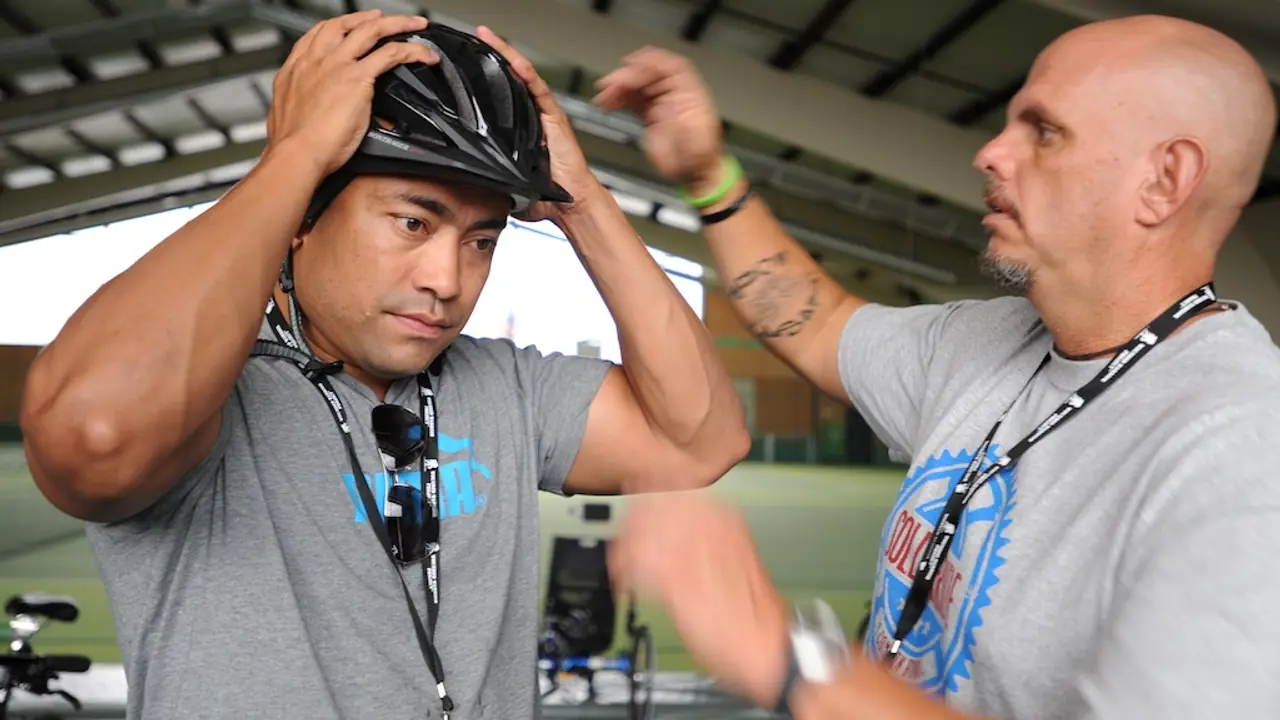
Yes — it is the most important thing you buy after the bike itself. Kids helmets have deeper rear coverage than adult ones because children fall backwards more. Check the fit: two fingers above the eyebrow, the straps forming a V under each ear, and one finger between strap and chin.